Jean Fouquet, born at Tours in 1420, was a painter and illustrator responsible in part for bringing Renaissance technique to the French. Probably in 1465 he was commissioned by the Duke of Armagnac to illustrate a vernacular edition of Flavius Josephus, the single work of Greek historiography available (through Latin translation) until the renaissance and in extraordinarily extensive circulation--even through the Enlightenment one would frequently find
Jewish Antiquities and the
Bellum Judaicum shelved next to the Bible in educated households, since it was used as a supplement for the historical lacuna between Torah and the new testament. I ran across this illumination by chance when I happened to be reading about
Solomonic columns on Wikipedia, and I've been thinking about it for a few months now.
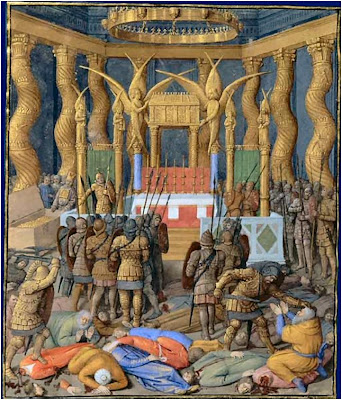 Pompée dans le Temple de Jérusalem
. For sake of comparison, have a look at Josephus,
Bellum Judaicum 7.4ff, conveniently available online in a very nice facing edition. (The illumination treats the desecration itself--
Bel. Jud. 7.6.)
Medieval views of antiquity are a sure bet if you want to put your day off-center with a nudge from the uncanny. There are a couple of things about this image that I find enormously striking--Fouquet managed to get the strangeness of the
kodesh haKodashim exactly right; the human tumult is so out of place beneath that gold-on-indigo monotony, all those bodies fenced in by undulating static space. Fouquet had
previously drawn the facade of the temple as though it were a Gothic cathedral, but here you can see him struggling against the contemporary and toward the alien--the altar area is familiar from Christian worship, but from the candlesticks upward he sweeps into an inhuman and frightening holiness.
I thrill a little when artists recognize the deeply alien voice of the Torah. It's too easy to humanize G-d and archaeologize Jewish antiquity--I like to say that Abraham invented the abstract, but the uncanniness of that G-d is more iridescent and enigmatic than
logos. It only gets stranger by Sinai--think of Jacob's hip or Zipporah at the crossroads! Whatever spoke to Moses out of the bush is
not a humanist divinity.
I identify with Pompey. That curiosity of his (was it burning, or only indifferently analytical?) brought him over the bodies of the dead into the inviolate sanctuary, and here we have him unwilling to touch the sacred treasury--not so much because he was overawed by the enormity of his crime but out of a misplaced and very Roman
pietas;
fas and
nefas can't even begin to explain the suicidal horror of the Jews when the temple was desecrated. It's revealing that his attention was diverted to the temple treasure instead of the Ark. He was a good man and a great Roman, but the endless centuries of power and paganism can only take you so far. It's pointless to say he should have been flat on his face--too much understanding can take a man apart.
He looks so small.
Sometimes you encounter a piece of artwork that strikes you as a kind of spiritual portrait of yourself, floating out in the
logos waiting to reattach itself to you--vehicle waiting for a tenor. But believe me, the position of a gentile come into sudden contact with the terror and majesty of haShem is an unenviable one; I can't judge Pompey too severely, particularly not here--I understand him too well.
Cf. Tacitus,
Historiae 5.9;
Shemot 4.24-26;
B. Britten, Canticle 2: "Abraham and Isaac" (The
Ian Bostridge version is
monumentally good). More from Fouquet can be found
here and
here.


